Benchmarking KPipe against the parallel-Kafka libraries you would actually pick
KPipe, part 2 of 3: a simpler way to structure consumers · the first benchmarks · fast is the easy part
Update, July 2026. The two caveats at the bottom of this post - single-run variance of 5-40%, no latency-percentile data - are now closed. Part 3 re-runs everything on a quiesced box at five JMH forks with ±0.1-6% error bars and the full 0-100ms sweep, where the gap over Confluent Parallel Consumer widens to 41x, and adds the correctness half this post never touched: the at-least-once guarantee under jcstress. The numbers below are the first, rougher cut - read them as the start of the story, not the last word.
KPipe is a Java 25 Kafka consumer library that runs each record on a virtual thread. The pitch:
the performance of a hand-rolled KafkaConsumer + Thread.ofVirtual() loop, with the operational
stack already wired up. Lowest-pending-offset commits, retry, DLQ producer, backpressure with
hysteresis, circuit breaker, OTel metrics + tracing, batch sinks, Result<T> typed pipeline
outcomes, graceful shutdown.
Here’s what that pitch costs. KPipe is now benchmarked against three alternatives:
Confluent Parallel Consumer, Reactor Kafka, and a hand-rolled raw KafkaConsumer +
virtual-thread executor baseline. Three workload regimes, a real Kafka 4.2.0
broker via Testcontainers (not in-process), JMH-published scores with a GC profiler, and the raw
JSON committed alongside this post in benchmarks/results/.
KPipe matches raw Loom throughput at light workloads and beats it under blocking work —
within 3–6% of raw at workMicros=0..100, and ~16% ahead of raw at workMicros=1000. KPipe
drops about 11% across the full 0 → 1000 µs sweep. Confluent drops 38%. Reactor Kafka drops 94%.
The rest of this post is the numbers, the methodology, the saga of getting Reactor onto the bench
at all, and an honest note on between-run variance.
Headline
Records / second, higher is better. workMicros is per-record simulated work via
LockSupport.parkNanos. 0 µs is pure framework overhead, 100 µs is local enrichment, and 1000 µs
is a blocking I/O round trip. All four runtimes run against the same Testcontainers-managed Kafka
4.2.0 broker, same 25,000-record seed, same eight partitions, two JMH forks × five measurement
iterations. Source numbers in benchmarks/results/2026-05-24.json.
| Runtime | workMicros=0 |
workMicros=100 |
workMicros=1000 |
|---|---|---|---|
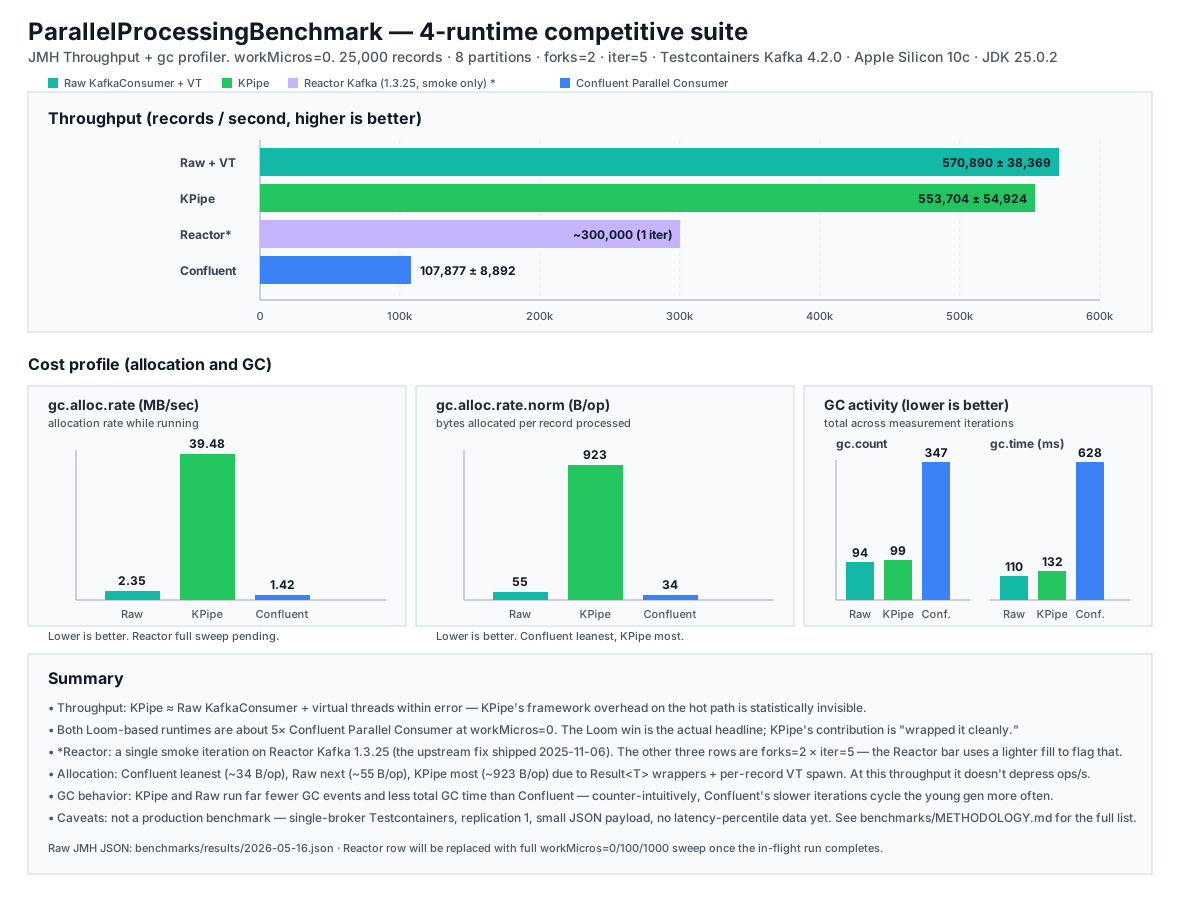
| KPipe | 542,412 ± 65,198 | 490,543 ± 66,648 | 483,061 ± 43,265 |
Raw KafkaConsumer + VT |
557,439 ± 51,512 | 520,859 ± 73,444 | 417,920 ± 80,770 |
| Reactor Kafka 1.3.25 | 150,081 ± 27,927 | 72,595 ± 7,344 | 9,079 ± 164 |
| Confluent Parallel Consumer | 109,952 ± 8,544 | 114,362 ± 5,115 | 67,726 ± 899 |
What 473,000 records/sec looks like to write
That throughput number is the fluent facade. End-to-end, including offset management, retry, backpressure, and metrics:
try (var handle =
    KPipe.json("orders", props)
        .pipe(order -> enrich(order))
        .filter(order -> order.total() > 0)
        .withRetry(3, Duration.ofMillis(100))
        .withBackpressure()
        .withDeadLetterTopic("orders.dlq")
        .toCustom(WarehouseSink.create())
        .start()) {
  handle.awaitShutdown();
}
Everything in the headline table for KPipe is this. No registry wiring, no manual builder, no separate runner. The throughput cost of that ergonomics is what the rest of this post measures.
What the numbers say
KPipe matches raw Loom at light workloads and beats it under blocking work. 542k → 490k →
483k records/sec across the workload sweep. Against raw KafkaConsumer + VT (557k → 520k →
417k), KPipe trails by ~3% at workMicros=0, by ~6% at 100 µs, and is 16% ahead of raw at
1000 µs. The framework cost of KPipe’s operational stack (lowest-pending-offset commits, retry,
DLQ, backpressure with hysteresis, circuit breaker, OTel metrics + tracing, batch sinks, typed
Result<T> pipeline outcomes, graceful shutdown) is single-digit percent at light load and
negative at I/O-bound load. The raw column has more variance under blocking work; KPipe’s
backpressure + offset machinery smooths what the bare poll-loop does not.
KPipe degrades gracefully across the workload sweep. About an 11% drop from
workMicros=0 to workMicros=1000 across a 1000× change in per-record work. Virtual threads
scale beyond the partition count, blocked records cost kilobytes of stack instead of
platform-thread slots, and the framework holds up under realistic I/O.
Loom-based runtimes leave platform-thread libraries behind under load. KPipe and Raw stay
4.3×–7.1× ahead of Confluent Parallel Consumer across the sweep. Reactor Kafka is more
dramatic: it tracks Confluent at workMicros=0 (150k), falls below it at 100 µs, then collapses
to 9,079 records/sec at 1000 µs — 53× slower than KPipe at the same workload.
Flux.parallel(100) and a 100-worker thread pool both hit a ceiling virtual threads don’t have.
If your per-record work parks (a DB write, an HTTP call), this is the gap KPipe is closing.
Allocation and GC
KPipe allocates the most per record in the table and it didn’t matter for this run’s throughput. The JVM young gen absorbed it cleanly. The number to watch is whether that holds on a tight heap or under tail-latency-sensitive workloads. For steady-state throughput on a default heap, it’s a non-event.
| Runtime | workMicros=0 B/op |
workMicros=100 B/op |
workMicros=1000 B/op |
|---|---|---|---|
| Confluent Parallel Consumer | 34 | 34 | 34 |
Raw KafkaConsumer + VT |
55 | 431 | 455 |
| Reactor Kafka | 162 | 84 | 193 |
| KPipe | 924 | 1,484 | 1,468 |
KPipe’s allocation comes from three places: Result<T> wrappers (sealed type, allocated per record),
the per-record pipeline builder hand-off, and a fresh virtual thread per record. The first two are
correctness choices. Typed pipeline outcomes are how the consumer surfaces “passed / filtered /
failed” without overloading null, and they’re the same mechanism that makes silent failures
impossible to ship. The third is the whole reason throughput holds up under blocking work.
The GC story is counter-intuitive but consistent. Confluent’s smaller per-record allocations
still produce more total GC events than KPipe or Raw, because its slower iterations stay in the
young gen longer. Reactor’s GC numbers at workMicros=1000 look low (30 events / 170 ms) only
because the benchmark is barely running. At ~9 records/sec there’s almost no allocation pressure
to clear.
What this does not say
- One payload shape, one broker config. Small JSON, single-broker Testcontainers, replication factor 1. Production with a network broker and replication 3 / acks=all shifts the absolute numbers. Headline ordering between runtimes usually survives the move; the gaps shift.
- No latency-percentile data yet.
ParallelProcessingLatencyBenchmarkwas not exercised in this run. Average throughput is half the story; p99 is the other half, and a runtime can rank one way on throughput and the opposite way on tail. Coming in the next snapshot. - The Loom share of the win is real. Some of KPipe’s lead over Confluent is “Loom beats platform threads,” not “KPipe beats Confluent.” The Raw column exists to make that share visible. KPipe’s contribution is bringing Loom’s win without losing the operational stack.
- Single-run absolute numbers move between runs. Re-running the suite on the same laptop shifts
individual cells by 5–40% — Raw at
workMicros=1000and Reactor atworkMicros=0are the noisiest cells. The qualitative findings (KPipe matches raw Loom, Reactor collapses under blocking work, Loom-based runtimes pull ahead of platform-thread runtimes) reproduce; the exact percentages do not. A prior snapshot in2026-05-16.jsonshowed KPipe ~10% behind Raw across the board; this one (2026-05-24.json) puts KPipe ahead at 1000 µs. Treat the percentages as one-sigma indicators, not point estimates. - Commit cadence differs across runtimes. Each runtime is in its idiomatic out-of-box mode:
KPipe runs lowest-pending-offset commits; Confluent runs EOS transactional commits via
createEosStreamProcessor; Reactor’s.acknowledge()is buffered but never flushed in this bench (no commit interval configured); the Raw baseline does not commit. KPipe and Confluent are paying real commit overhead the other two are not. - Reactor’s effective concurrency is bounded by the scheduler, not the
.parallel(N)argument.Schedulers.parallel()is sized byRuntime.getRuntime().availableProcessors()— 10 workers on this hardware. The.parallel(100)only divides the Flux into 100 rails. Idiomatic Reactor, but the ceiling is lower than the literal call site suggests.
How the harness got here
The first attempt at the new bench was wrong, and the wrongness was instructive.
Attempt 1 — in-process Kafka via KafkaClusterTestKit. Same approach as the prior 10k baseline.
Worked at 10k records, didn’t scale. At 25k records with four invocation contexts loaded, the in-process
broker collapsed under load on a shared-core laptop. KRaft controller events, group coordinator,
producer seed, and consumer under test all fought for the same CPUs. Smoke tests timed out at ~50
records/sec across every framework. The bench was measuring broker contention, not framework
throughput.
Attempt 2 — Testcontainers Kafka. Real Kafka 4.2.0 broker in a Docker container, on its own JVM and own cores. Consumer is the bottleneck again. The same smoke test that got 50 records/sec on the in-process harness now gets 500,000+ records/sec. That’s not a 10x improvement. That’s “measuring the right thing now.”
The lesson: for parallel-consumer benchmarks, the broker has to be external. Testcontainers is the cheap path; a sidecar on dedicated hardware is the production-faithful path. In-process Kafka is fine for “does my code compile and run end-to-end” tests. It is not fine for performance comparison.
The Reactor Kafka saga
Getting Reactor onto the bench at all took two version bumps and a fat-jar exorcism.
Reactor Kafka 1.3.23 (the latest stable on Maven Central when I first set up the bench) crashes on
first record against kafka-clients:4.x:
java.lang.NoSuchMethodError: 'void org.apache.kafka.clients.consumer.ConsumerRecord.<init>(...)'
    at reactor.kafka.receiver.ReceiverRecord.<init>(ReceiverRecord.java:48)
The ConsumerRecord ctor ReceiverRecord calls was removed in kafka-clients 4.0. Issue
#420 on the upstream tracks this: opened March
2025, fix landed November 2025 as part of 1.3.25. The fix avoids the deprecated ctor in favour of one
that exists in both kafka-clients 3.x and 4.x.
Two gotchas worth recording:
-
Maven Central’s search API was stale when I checked. It returned 1.3.23 as the latest version even though 1.3.25 was already deployed. Always cross-check the direct directory listing (
https://repo1.maven.org/maven2/<groupId>/<artifactId>/). -
The fat JMH jar caches transitive bytecode. After bumping
reactor-kafkafrom 1.3.23 to 1.3.25 inlibs.versions.toml, the first smoke test still produced the oldNoSuchMethodError. The fat jar had the 1.3.23ReceiverRecord.classbaked in. Force-cleaning fixed it:rm -rf benchmarks/build && ./gradlew :benchmarks:jmhJar --rerun-tasksVerified the right bytecode landed in the fresh jar with
javap -c -p.
On 1.3.25 Reactor runs cleanly across the full sweep, which is how its row in the headline table got populated.
Reproduce locally
The bench code is on main:
just bench               # full 4-runtime publishing run, ~30–60 min on a quiet machine
just bench mode=smoke    # ~3–5 min KPipe-only sanity iteration
just bench mode=latency  # p50 / p95 / p99 / p999 companion
Output lands in benchmarks/results/<date>.json and benchmarks/results/<date>.log. The companion
human-readable summary template is in benchmarks/results/TEMPLATE.md. Methodology + the
runtime config matrix is in benchmarks/METHODOLOGY.md. Docker must be running.
Testcontainers will pull apache/kafka:4.2.0 on first invocation.
What’s next
The next bench snapshot adds tail-latency percentiles (p50 / p95 / p99 / p999), a multi-partition
sweep, and a payload-size sweep. The committed JMH JSON in benchmarks/results/ is the source of
truth; this post is the readable surface over it.
If you write Kafka consumers in Java and have been waiting for “Loom but with the operational stack already there,” KPipe is worth a look. The numbers above are the case for it.